

The demographic landslide: why birth rates are collapsing everywhere
Despite all the intellectual snobbery that surrounds academic economics, in my opinion, it is a subject more akin to collective fortune telling than it is to the precision of the natural sciences. Some would argue that it is our best attempt at predicting the complexity of future human behaviour based on historical observations, but it is this very limitation that makes it generally hopeless at anticipating and modelling the impact of frequent and sometimes profound changes in the way societies work. In my experience, its slavish attachment to historical correlations drowns out more pragmatic, common-sense observations, which I have found much more useful for understanding how an economy will behave in the future.
Having said that, demographics is widely regarded as the most predictable element of economics, albeit that, despite its reliability in, for example, estimating the size of the future working population based on the number of children already born, it does have its limitations. For example, demography is not good at anticipating how technology might be affecting fertility rates or attitudes to retirement.
I was reminded of this fundamental limitation when I bumped into a couple of unrelated but really interesting articles published in the FT over the last few months (both gift links). One focused on looking at how China's population is forecast to change over the next 75 years to the end of this century, and the other on what's happening to global fertility rates and what is affecting them. Both articles contained data that really surprised me; in fact, I was shocked by what I read, as has everyone I have spoken to about its implications.
Having read these articles, which challenged my more conventional thinking on global population trends, I checked out what bodies like the UN are saying about how the world's population will grow over the rest of this century, when it will peak and at what level, and where this growth will come from. Interestingly, much of what these widely recognised authorities have historically said about the outlook for the world’s population is now changing and seems destined to change further, perhaps radically, in the relatively near future. I also found some interesting anomalies in the data, which suggest that the UN's recent downward revisions to its estimate of global population in 2100 may already be wrong.
UN population projections
Let's start with the latest UN population projections to the end of this century. The context here is that, for some time, the UN has predicted that the global population would continue to grow uninterrupted well into the 22nd century. In 2022, the UN changed that perspective and forecast that the number of people would peak around 2080 at about 10.4 billion and then remain at that level. In its latest forecast (published in 2024 – there is another update due in 2026), it reduced that peak population estimate by 200 million to around 10.3 billion (in 2024, there were approximately 8.2 billion people in the world).
Quietly, the UN is in the process of a fundamental reassessment of global population forecasting largely because, as the secretary general for economic and social affairs said back in 2022, 'In some countries the birth rate is now even lower than previously anticipated, and we are also seeing slightly faster declines in some high-fertility regions'.
Perhaps the most striking data from these studies are the projections for China's working-age population (20–69), and indeed for India too. In the case of China, its working-age population peaked at just under 1.0 billion in 2025 and is now forecast to fall by just under 70% over the next 75 years to 320 million by the end of this century. Astonishingly, by then it will be only 9 million larger than the UN estimate for Nigeria's working-age population, only 77 million larger than the US, and, most remarkably, slightly smaller than Pakistan's.
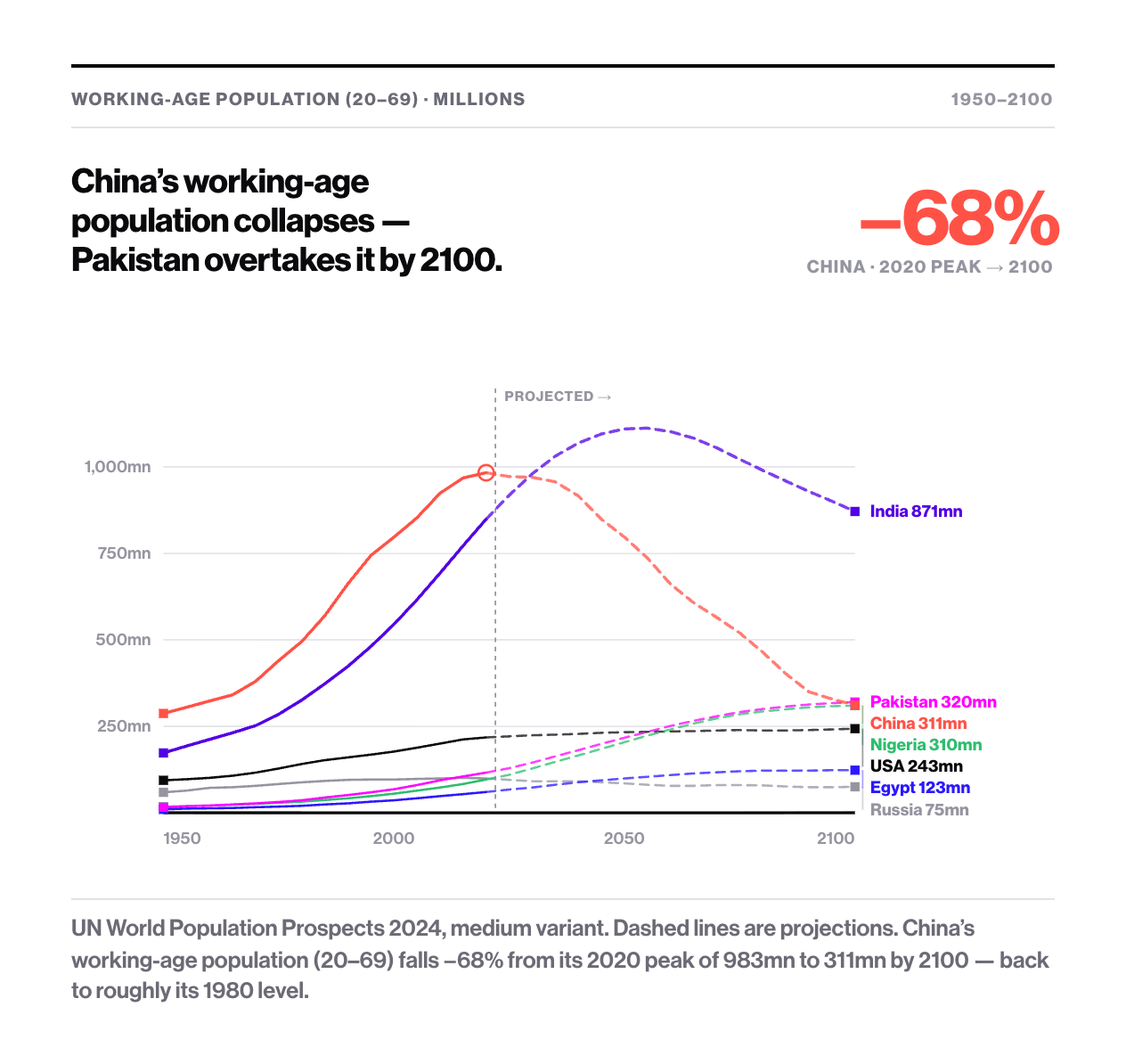
Peak Chinese?
Now, these astonishing data were compiled in 2022, before a more recent study on globally declining fertility rates, which I will come to a little later in this note. But I thought it might be worth pausing here for a moment to try to take in what a 70% fall in the working-age population might mean for China.
As a % of China's total population, the number of working-age adults is also set to decline dramatically from nearly 73% in 2009 to 46% in 2100. The most obvious implication is that unless there is some miraculous transformation in productivity, the Chinese economy is set to shrink dramatically over the rest of this century. It will also face increasingly severe manpower shortages across many industries, a lack of people to care for an ageing population, and huge surpluses of residential property and infrastructure – schools, universities, trains, buses, hospitals, etc. Maybe one can now see very clearly why China is so keen to invest in and lead humanoid robot technology.
Although I have yet to see anything written about what these revised population data mean for the UN's climate forecasts, I can't help thinking that the scarier scenarios now look even less likely, given that population size directly influences energy demand, land use, and, of course, greenhouse gas emissions. I digress.
Why are birth rates falling?
The more recent study I wanted to highlight is up to date and was also completed by the UN. It was discussed in an FT article published just about a month ago, entitled 'Why birth rates are falling everywhere, all at once’, and it opened with a pretty punchy statement:
'The demographic landslide defining our era is gaining speed – and terrain.'
Now, when I first read this, I thought it sounded a bit alarmist or even a bit sensational until I looked at the data, and then I concluded it was, if anything, a bit understated!
This later study also highlights why the 2024 projections shown in the chart above could already look very wrong, and I thought I should focus on what the chart above forecasts for Egypt to illustrate why.
An Egyptian example
Just two years ago, the UN projected that Egypt’s population would grow from 67 million in 2025 to 123 million by 2100. (That's about growth of 1% per annum over 75 years.) This near-doubling, I presume, was based on Egypt’s relatively recent fertility rate, which, although it has been consistently falling since 1990, was still around 3 (the average number of children a woman would have). To put this into context, in the developed world, the replacement rate (the number of children needed to keep a population static) is 2.1, and in the developing world, it's about 2.3.
However, in the more recent study into global fertility rates and the likely cause of their consistent, worldwide collapse, Egypt’s fertility rate has continued to fall and, in 2023, was down to 2.5, only just above the replacement rate. Perhaps more worrying, in some respects, is that this decline has clearly accelerated since 2015, as it has in a range of other developing countries, including Iran, Senegal, Indonesia, Peru, Chile, Turkey, Tunisia, Thailand and Mexico. In fact, birth rates have been falling everywhere and, perhaps remarkably, at 1.4, Mexico now has a lower birth rate than America.
Antisocial media?
To answer the question of why this dramatic change has taken place, the study analysed social behaviour across the world in developed and developing countries with completely different religions and cultures, and worryingly found a very similar trend everywhere, which was reflected in data showing a widespread collapse in the percentage of young adults getting married or cohabiting, leading to fewer women becoming mothers.

In looking for the cause of these dramatic changes, the study examined all the politicians’ favourite culprits, including housing, education, female participation rates in the workforce, and wealth. None explained the results that were being seen everywhere. Then the data were mapped against the roll-out of digital devices and social media platforms, and what emerged was an incredibly consistent picture across every country that had rolled out 4G mobile networks.
This is an extract from the article which explains what's happening very clearly:
The number of births fell first and fastest in the areas that received high-speed mobile connectivity earliest. The authors argue that smartphones have transformed how young people spend time with one another, sharply reducing in-person socialising and leading to a collapse in their fertility.
FT research indicates the same trend has affected other countries.
For example, US, British, and Australian birth rates among teens and young adults were broadly flat during the early 2000s but began to fall markedly from 2007.
The same slide began in France and Poland around 2009, and in Mexico, Morocco and Indonesia around 2012. What had been steady declines in fertility in Ghana, Nigeria and Senegal became precipitous drops between 2013 and 2015.
All of these inflection points coincided with the mass adoption of smartphones in local markets — as measured by Google searches for mobile apps.
And if anyone was in any doubt about this, here is the graphic showing how fertility rates have collapsed in a consistent fashion across all countries in this sample, which includes Senegal, Iran, Egypt, Indonesia, the US, the UK, Australia, and Mexico.

Interestingly, in every country studied, the same pattern emerged: the birth rate collapsed after the introduction of smartphones, regardless of the previous fertility trend, and the younger the age group, the more pronounced the downturn, mirroring smartphone usage patterns.
Conclusions
Whilst politicians have been debating how to protect children and young people from the harmful effects of smartphones and social media without stifling freedoms and technological progress, the mental health epidemic and worrying levels of addiction in the young are getting worse.
But it appears that these harmful effects are not just impacting teens and school kids; it seems clear that smartphone usage is also having a profound impact across the world on fertility, which is collapsing pretty much everywhere.
Some may see this as good news for a planet that many believe will struggle to cope with 10 billion people and the impact population growth will have on CO₂ emissions, agriculture, the environment and the natural world. Others may worry more that many developing economies will now get old before they get rich.
Either way, I struggle to see how this genie can be shoved back into the bottle from which it came, which, if I’m right, means that forecasts of global population growth will continue to fall, which in turn will have profound economic implications for everyone, everywhere.
I've always thought economics was closer to fortune telling than science, and demographics was the one corner of it I trusted. Two FT articles have shaken even that.
The first looks at how China's population changes to 2100. Its working-age population (20–69) peaked just under 1.0 billion in 2025 and is forecast to fall by nearly 70% to 320 million by the end of the century. By then China's workforce will be only marginally bigger than Nigeria's, smaller than Pakistan's, and barely ahead of the US. Unless productivity is miraculously transformed, the Chinese economy shrinks – with chronic labour shortages and huge surpluses of housing and infrastructure. Now you see why Beijing is so determined to lead on humanoid robots.
The second article is the one that genuinely shocked me. The UN keeps cutting its peak global population estimate – now around 10.3 billion – and the latest fertility data say even that is too high. Egypt was meant to nearly double to 123 million by 2100. Its fertility rate is already down to 2.5 and still falling. The same collapse is happening across Iran, Indonesia, Turkey, Mexico and dozens more, regardless of religion, culture or wealth.
The cause isn't housing or education or female participation. When the data are mapped against the roll-out of 4G and smartphones, the picture is brutally consistent: in every country, birth rates fall off a cliff once smartphones take off, and the younger the cohort, the sharper the drop. Fewer young people are marrying or cohabiting, so fewer are having children.
Some will call this good news for the planet. Others will worry that much of the developing world now gets old before it gets rich. Either way, I don't see how this genie goes back in the bottle. Population forecasts will keep falling, and the economic consequences will be profound – for everyone, everywhere.
Related posts

Subscribe to receive Woodford Views in your Inbox
Subscribe for insightful analysis that breaks free from mainstream narratives.