

Roundup of the week: Inflation Falls Faster Than Expected in US and UK
Naturally, this week has been relatively quiet as the usual seasonal lull begins to take hold of financial markets. There have been a few notable events, though, which are worth commenting on, and I will cover the most significant in this note.
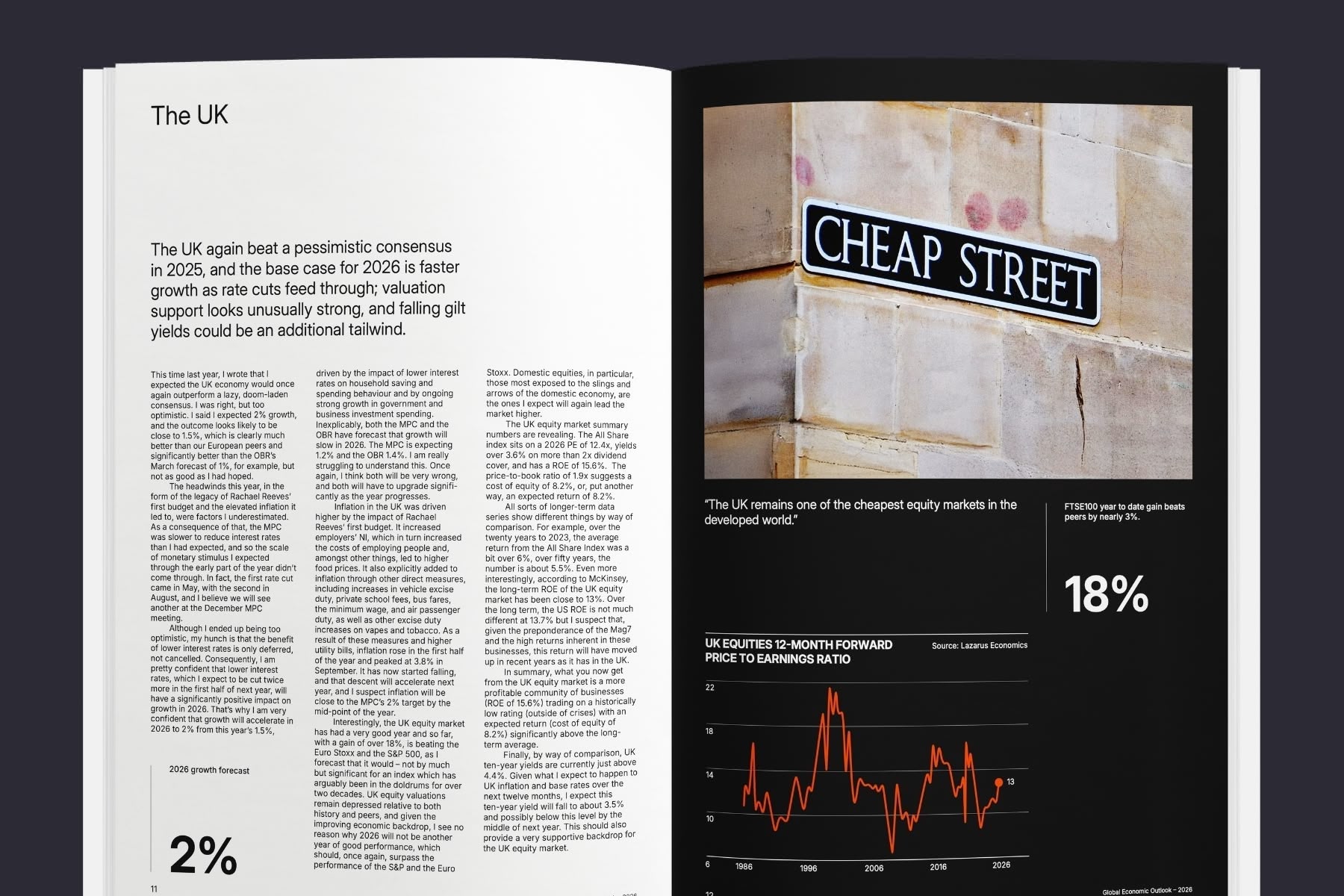
In case you missed it, I published my 2026 global economic outlook earlier in the week. We also discussed how I see the world as we head towards 2026 in last week's Noise Cancelling podcast.
This is the last weekly round-up of 2025. As I sign off for this year, I wish all of my readers a very happy Christmas and a happy, healthy, and prosperous New Year.
Politics
Moves to bring about a peace deal in Ukraine have intensified this week. In parallel, the EU is still grappling with access to Russia’s frozen assets in Euroclear. The holdout, Belgium, is still unhappy about the proposed deal, but at last, it seems the rest of the EU, except Hungary, is determined to stop the endless talking and finally reach a decision. Given that Ukraine is likely to run out of funding in 2026, the situation could hardly be more urgent.
The discussions on a peace deal have focused on reaching an agreement among the US, Ukraine, and its European allies, including the UK (or European piglets, as President Putin is now referring to them), ahead of presenting an agreed deal to the Russian President. In the meantime, discussions have been taking place between the Russians and the US, and a meeting between the two delegations is scheduled for Miami over the weekend.
The deal that appears to be coming together includes critical security guarantees for Ukraine, alongside other features that, in the past, have apparently been unacceptable to the Russian President. Whether he will change his mind this time is unclear, but judging by his previous rhetoric on red lines, I would be surprised if this deal were acceptable to him. I hope I am wrong, but right now I am not overly optimistic.
If a peace deal were to be agreed, I suspect that the concessions to Russia would include lifting embargoes on its oil exports. This would have an immediate effect on the oil price, which has been relatively weak this year and therefore knock-on effects on global energy prices and on inflation, which is already headed down almost everywhere. In this scenario, I could imagine a situation in which talk of too little inflation could quickly replace the current favourite topic of central bankers, namely sticky inflation.
Economics
US
Among all the data emerging from the US this week, as it catches up from the government shutdown, the most interesting is the inflation data. The consensus had the November CPI at 3.1% and the core CPI at 3%. The release today shows that headline CPI was in fact 2.7% in November and core CPI at 2.6%. This looks significant to me and has already begun to impact the Treasury market, which is rallying. Remember that the Fed and most consensus economists have been wringing their hands about sticky inflation and the lagged effects of Trump’s tariff measures. Based on today’s numbers, those concerns appear to have been misplaced. I have been arguing for months that the consensus was too pessimistic about inflation, and it seems, just as in the UK, that the central bankers, the herd of economists, and the commentators were once again wrong. In fact, so surprising are today’s data to the discombobulated consensus that there is already talk of this report being a statistical blip.
In summary, this inflation report increases my confidence in my call that inflation and interest rates fall faster than expected in the US in 2026. Obviously, this is positive for bonds and for the equity market.
UK
Earlier in the week, the ONS also released much better-than-expected inflation data. Consensus and the MPC were expecting a 3.4% outturn for November. In fact, UK CPI in November was 3.2%, down significantly from July’s peak of 3.8%. Of particular note were lower food price inflation, lower goods prices, clothing and rents.
These better-than-expected inflation data were clearly mulled over at the following day’s MPC meeting. Unfortunately, too many members of this committee (4) are still obsessing about sticky inflation and waffling on about the neutral rate of interest and how close we are to it. (They have no idea what it is, by the way.) Instead, they should acknowledge the factors that caused the blip in inflation (2024’s budget) in the first place and its one-off nature. They should recognise that pre-budget speculation damaged business and consumer confidence. And they should look at the disinflationary forces bearing down on the headline rate in 2026. That said, thankfully, the majority of the committee did not share the sticky inflation view, and the committee voted for a 25 bps cut.
Importantly, the commentary accompanying the decision was less hawkish and acknowledged that inflation is now likely to fall back to near the 2% target more quickly in 2026, potentially by the second quarter. This is significant and bodes well for further rate reductions in the first half of next year, which aligns more with my more bullish inflation and interest rate expectations.
Markets
Micron
Amidst the recent gloom about the scale of AI investment and the ability of some companies to finance their commitments, Micron’s results came as a welcome relief. Micron is one of the world’s leading manufacturers of memory chips, including HBM chips, which are critical to systems used to train LLMs. In the first quarter, both sales and profits beat expectations. In particular, earnings per share were 21% ahead of consensus. However, the most surprising feature of the earnings report was the guidance for Q2. The CEO said that revenues would be between $18.3 and $19.1bn (analysts were expecting $14.4bn) and earnings per share would be somewhere between $8.22 and $8.62 (analysts were expecting $4.71).
The CEO commented that Micron is positioned as an “essential AI enabler” and his chief operations executive said that “this is the most significant disconnect between demand and supply …that I’ve experienced in 25 years in the industry” The implication here is that shortages across the semiconductor industry are driving prices up and that sustained strong demand is likely to continue beyond calendar 2026.
If you’d prefer to watch or listen, we covered many of these themes — and the broader outlook for 2026 — in last week’s Noise Cancelling episode.
As the seasonal lull sets in, this week delivered one genuinely important development: inflation data in both the US and the UK surprised sharply to the downside. That matters far more than most of the political noise.
On geopolitics, efforts to broker a Ukraine peace deal have intensified, alongside renewed pressure within the EU to finally unlock Russia’s frozen assets. Whether any agreement is acceptable to Moscow remains doubtful. If a deal were reached, lifting restrictions on Russian oil exports could push energy prices lower and accelerate the global disinflation already underway.
In the US, November CPI came in well below expectations — headline inflation at 2.7% and core at 2.6%. This directly undermines the consensus obsession with “sticky inflation” and reinforces my long-held view that both inflation and interest rates will fall faster than expected in 2026. Bond markets have already reacted positively.
The UK saw a similar story. Inflation dropped to 3.2%, again beating forecasts, with food, goods and rents all easing. The MPC finally responded with a 25bp rate cut. More importantly, its commentary was noticeably less hawkish, acknowledging that inflation could return close to target by Q2 next year — opening the door to further cuts sooner rather than later.
In markets, Micron’s results were a standout. Sales, profits and guidance all crushed expectations, with management highlighting severe supply shortages in AI-related memory chips. Far from an AI slowdown, this points to sustained demand well into 2026 and beyond.
In short: inflation is falling faster than policymakers expected, rates are heading lower, and the AI investment cycle remains very much alive. A fitting — and encouraging — note on which to end 2025.
If you’d prefer to watch or listen, we covered many of these themes — and the broader outlook for 2026 — in last week’s Noise Cancelling episode.
Related posts

Subscribe to receive Woodford Views in your Inbox
Subscribe for insightful analysis that breaks free from mainstream narratives.